Ever feel like AI is only for the coding geniuses — the hoodie-wearing folks who speak Python better than English? Yeah, me too.
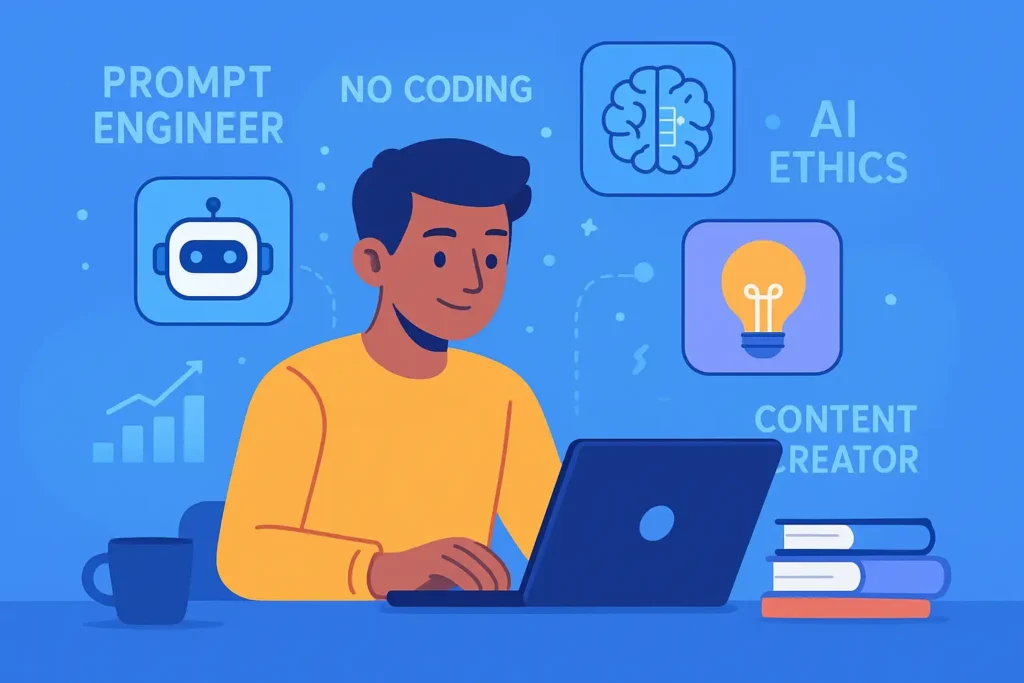
But here’s the exciting truth: a career in AI 2025 without coding is totally possible — and it’s not just some clickbait idea. Whether you’re a writer, designer, teacher, marketer, or just someone curious about tech, there’s a place for you in the world of AI.
So grab a coffee (or chai), and let’s talk about how you can ride the AI wave — no coding required.
First Things First: What Is AI, Really?
Let’s clear the air. AI isn’t a robot apocalypse waiting to happen (unless Hollywood is right 😅). In real life, AI (Artificial Intelligence) is simply tech that can learn, reason, and make decisions — kind of like a human brain, but with more memory and no sleep.
You already use AI every day:
- Netflix recommends a thriller you actually like.
- Google auto-fills your search before you even finish typing.
- Siri reminds you to call mom (even though you ignore her… again).
That’s AI doing its thing. And the cool part? The AI industry needs people like you to help it grow — not just code it.
So, Can You Really Build a Career in AI 2025 Without Coding?
Short answer? YES.
AI is not just one big job titled “AI Engineer.” It’s an ecosystem filled with roles that require creativity, strategy, empathy, and communication — not just code.
As AI grows, companies need:
- People to teach AI what’s ethical and fair
- People to manage AI-powered projects
- People to explain AI to the rest of us
- People to design, write about, and market AI products
Let’s break down some of these non-coding AI jobs you could step into by 2025.
Top Career Options in AI 2025 Without Coding
1. AI Product Manager
Ever been the “organizer friend” who plans the trip, books the tickets, and still remembers everyone’s allergies? That’s basically what an AI Product Manager does — just with apps and AI models instead of hotel rooms.
You don’t need to write code — but you do need to understand how AI works and what users need. Your job? Make sure the AI product delivers value.
💡 Bonus: This role pays super well and is perfect for people with business or management backgrounds.
2. AI Ethics Specialist
AI can be smart — but not always fair. Remember those stories about AI hiring tools being biased? That’s why companies now hire AI ethics experts.
You’ll work on:
- Identifying bias in AI systems
- Ensuring privacy is protected
- Helping design AI that’s inclusive and transparent
No code needed — just a solid moral compass, common sense, and the ability to ask tough questions.
3. Prompt Engineer (Yes, It’s a Real Job!)
Ever asked ChatGPT to write a joke, create a resume, or explain quantum physics like you’re five? That’s prompting.
Now imagine doing it professionally.
Prompt Engineers are becoming a hot new role — you basically train AI tools like ChatGPT to respond the right way by asking the right questions.
No technical background? No problem. You just need creativity and language skills.
4. AI Content Writer / Explainer
Not everyone speaks tech. That’s where you come in.
Whether it’s writing blog posts (like this one 😉), UX copy, training documentation, or marketing content, AI writers make complex things understandable.
You’ll help users, clients, and teams know how to use AI — and why it matters.
Bonus: You’ll probably get to test the latest tools before the rest of us do!
5. Data Labeling & Annotation Specialist
For AI to learn, it needs data — labeled data.
Imagine helping a system recognize cats by tagging thousands of cat pictures. Or teaching a voice assistant to understand different accents by reviewing recordings.
It’s detail-oriented work, but crucial for training AI — and easy to start without coding skills.
How to Get Started Without Writing Code
So, you’re convinced this is possible (yay!), but now you’re thinking — “Where do I even start?”
Here’s your no-nonsense game plan:
1. Learn the Basics of AI
No, you don’t need a degree from MIT. Start small:
- Watch YouTube videos explaining AI in plain English
- Take free beginner courses on platforms like Coursera, edX, or Google AI
- Read blogs, follow AI creators on LinkedIn or Twitter
Keyword to search: “AI for Non-Tech Beginners”
2. Pick a Role That Matches You
Are you a creative? Go for content writing or prompt engineering.
Love organizing things? Product management might be your jam.
Big on fairness and inclusion? Ethics, baby!
Start from your strengths, not what you think you should do.
3. Experiment With AI Tools
Hands-on is the best teacher. Play around with:
- ChatGPT – for content, ideas, explanations
- Notion AI – for organizing thoughts and planning
- Canva AI – to generate designs quickly
- RunwayML – for AI-powered video editing
- Google Bard or Gemini – for creative projects
The more tools you explore, the clearer your career path gets.
4. Build a Mini Portfolio
Create and share:
- AI-generated content samples
- Articles explaining AI tools
- Prompt examples and tutorials
- Ethical discussions on AI in your industry
Even 3–4 solid pieces on LinkedIn or Medium can help you stand out.
5. Stay Curious, Stay Updated
AI is changing fast. What’s hot today might be outdated tomorrow.
Make it a habit to:
- Join AI communities
- Subscribe to newsletters
- Attend free webinars or online meetups
You’ll stay ahead of the curve — without drowning in code.
Final Thoughts: There’s Room for You in AI
A career in AI 2025 without coding isn’t just possible — it’s full of exciting opportunities for creative, curious minds.
Whether you’re fresh out of college, mid-career, or just exploring options, AI is one of the fastest-growing fields you can be a part of — even if you’ve never written a single line of code.
So, why not dip your toes in?
Try an AI tool. Take a free course. Explore a non-technical role. You might just find yourself in a career you love — powered by AI, driven by you.
People Also Ask (FAQs)
What is Artificial Intelligence?
AI is a branch of tech that allows machines to learn, think, and solve problems like humans. It powers tools like Google Maps, Netflix recommendations, chatbots, and self-driving cars.
How is AI used in daily life?
From voice assistants (like Siri) and shopping suggestions to spam filters and language translation — AI is part of everyday life, often without us realizing it.
Is AI dangerous?
Not inherently. But misuse, lack of regulation, and bias in AI systems can be risky. That’s why ethics and responsible AI practices are becoming so important.
Can AI replace humans?
AI can handle repetitive tasks but lacks human qualities like empathy, judgment, and creativity. So, it’s better as a helper — not a replacement.
How can students learn AI without coding?
Start with beginner-friendly resources, experiment with AI tools, and focus on creative or strategic roles. You don’t need to code to be AI-smart.