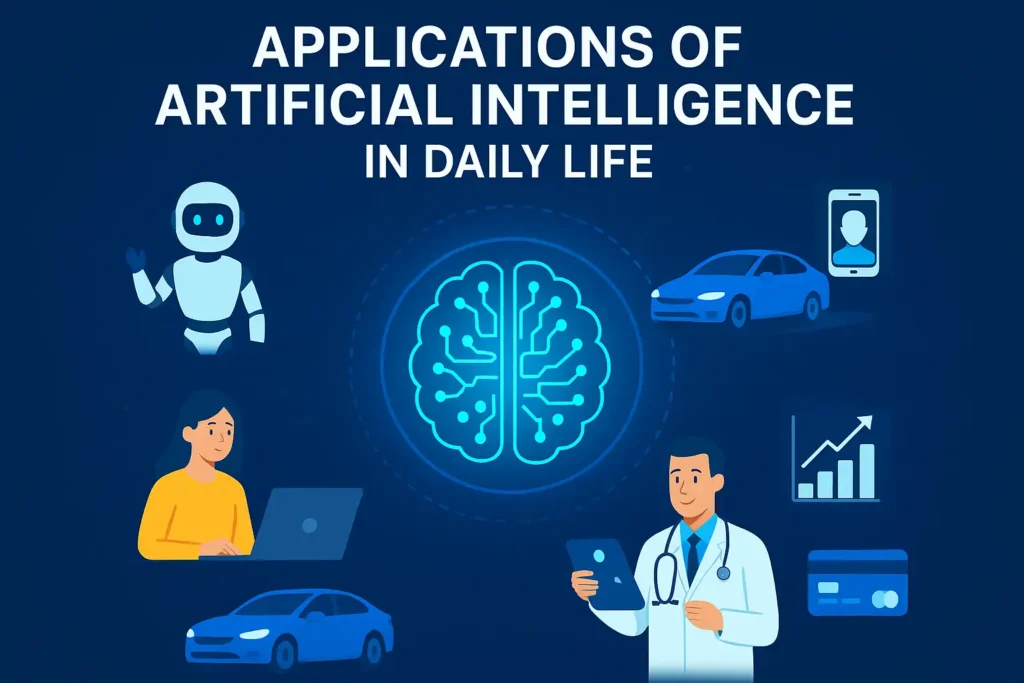
Ever wondered how your phone knows what you’re about to type next, or how Netflix magically recommends shows you actually like? That’s not some kind of black magic — it’s Artificial Intelligence (AI) working behind the scenes like your digital fairy godmother.
In this post, let’s talk casually (like two friends chatting over chai or coffee) about what are the applications of artificial intelligence are, and how it’s slowly becoming a part of our daily lives — without us even noticing!
So, What Is Artificial Intelligence, Really?
Alright, before we dive into the cool stuff AI does, let’s quickly understand what AI is — without sounding like a textbook.
“Students are already using AI to plan their study schedules, summarize notes, and even create mock tests. Here’s a complete guide on how AI can help with exam revision — it’s seriously a game-changer.”
Artificial Intelligence is basically when machines (like your phone, computer, or even your washing machine!) learn to “think” and “decide” like humans — well, kind of. They don’t exactly grow feelings (yet 😅), but they can:
-
Analyze data,
-
Recognize patterns,
-
Learn from experiences,
-
And make decisions based on that learning.
Think of AI as the brain behind smart tech. It helps machines behave intelligently — and sometimes even better than humans (ouch).
How AI Is Already Part of Your Daily Life
You don’t need to be a tech wizard to use AI. In fact, you already use AI every single day — without even realizing it. Don’t believe me? Check this out:
1. Online Shopping & Recommendations
Ever browsed Amazon and suddenly it’s like the site knows what you want? That’s AI.
-
Product suggestions are based on your browsing habits.
-
Chatbots assist you 24/7 (without ever sleeping).
-
Dynamic pricing changes based on demand, availability, and even your behavior.
Basically, AI = your personal shopper 🛍️
2. Smartphones That Know You
AI is literally baked into your phone. Here’s how:

India is becoming a hub for innovation, especially in AI. Want to see who’s leading the charge? Check out our list of the Top 50 AI Startups in India
— you’ll be surprised by what some of them are building.”
-
Face unlock? That’s AI recognizing your face.
-
Autocorrect and predictive text? AI’s trying to guess what you’re typing (sometimes terribly).
-
Voice assistants like Siri, Alexa, or Google Assistant? 100% AI-powered.
They might not always “get you” — but they’re learning, and fast.
3. Social Media Algorithms
Ever scroll Instagram and get stuck for hours watching reels about cats, cooking, or conspiracy theories? You can thank AI.

“Worried AI might take away your job? Why not get ahead of it? Explore these AI careers in 2025 that don’t require coding
— and yes, they actually pay well!”
-
It curates your feed based on what you like.
-
It recommends friends.
-
It even flags inappropriate content.
In short, AI controls what you see — and keeps you hooked (clever, right?).
4. AI in Cars and Navigation
Whether you’re using Google Maps or sitting in a Tesla, AI is making the journey smoother:
-
Navigation apps predict traffic and give you shortcuts.
-
Self-driving cars use AI to “see” and react to surroundings.
-
Driver-assist features like automatic braking, lane detection, and parking help.
Basically, it’s like having a robot co-pilot.
5. Healthcare & Diagnostics
Now this one’s life-changing.

-
AI helps detect diseases from scans (sometimes even faster than doctors).
-
It powers virtual health assistants.
-
It helps hospitals manage patient data and predict risks.
For example, AI systems have been trained to detect breast cancer from mammograms with high accuracy.
6. Language & Communication
Ever used Google Translate or Grammarly?
-
AI translates entire languages.
-
Voice-to-text and speech recognition tools help users with disabilities.
-
ChatGPT (yes, me!) is AI helping you write blogs, emails, essays — even love letters 😏
Language barriers? AI says — not anymore.
7. Banking & Finance
From fraud detection to budgeting apps — AI keeps your money smarter.
-
AI bots flag suspicious transactions in real time.
-
Credit scoring models use AI to predict loan risk.
-
Apps like CRED or YNAB use AI to analyze your spending patterns and offer suggestions.
AI doesn’t just handle money — it protects it.
8. Entertainment & Gaming
If you’ve ever played FIFA, PUBG, or even Candy Crush, you’ve already played against AI.
-
Game opponents often learn and adapt based on how you play.
-
Streaming platforms like Netflix, Spotify, and YouTube recommend content you’ll probably love.
-
AI even helps create music, write scripts, and edit videos!
So yes, AI is not only smart — it’s creative too.
So, What Are the Applications of Artificial Intelligence in Real Life?
Let’s bring it all together. Here’s a quick rundown of where AI is actively working behind the scenes:
Real-Life AI Applications:
-
Voice assistants (Google, Siri, Alexa)
-
Image and face recognition (Face ID, Facebook tags)
-
Smart home devices (lights, thermostats)
-
Email spam filters
-
Personalized news feeds
-
Fraud detection systems
-
Chatbots and customer service bots
-
AI-powered resume screeners for HR
-
Virtual teachers and AI tutors
-
Medical diagnostics tools
Pretty impressive, right?
Benefits of AI (Why Everyone’s Obsessed)
Let’s be real — AI has some seriously cool perks:
The Good Stuff:
-
Saves time (automation FTW!)
-
Makes better decisions using data
-
Available 24/7 (no coffee breaks needed)
-
Reduces human error
-
Personalizes your experience
Imagine a world where your fridge orders milk when it’s about to run out — we’re nearly there.
But AI Isn’t Perfect: Limitations to Know
While AI feels magical, it’s not without flaws:
The Not-So-Great Stuff:
-
Can be biased (based on the data it’s trained on)
-
Doesn’t have “common sense”
-
High cost to develop and implement
-
Job disruption in some sectors
-
Privacy concerns (yes, it’s watching you 👀)
So yeah — awesome, but with caution.
The Future of AI: Where Are We Headed?
Brace yourself — things are about to get wild.
AI is expected to:
-
Powerfully autonomous vehicles
-
Help with space exploration
-
Be a part of personalized education
-
Detect early signs of mental health issues
-
Assist in climate modeling and disaster prediction
But don’t worry, it’s not here to replace us — it’s here to work with us (unless Skynet becomes real, then… run 😅).
How Can You Start Learning or Using AI?
You don’t need a computer science degree. Here’s how to start:
Learn AI Online:
-
Free courses on Coursera, Udemy, and Google AI
-
Try YouTube channels like Simplilearn, freeCodeCamp
-
Explore tools like:
-
ChatGPT for writing & research
-
Canva AI for design
-
Notion AI for productivity
-
Use AI in Daily Tasks:
-
AI tools for students: QuillBot, Grammarly, Socratic
-
AI in blogging: Jasper, SurferSEO
-
AI in business: Chatbots, analytics, automation tools
Start small — but start today!
Final Thoughts
So there you have it — your friendly guide to what are the applications of artificial intelligence.
AI isn’t just some sci-fi concept anymore. It’s in your phone, your fridge, your car, and maybe even in the tool you’re using to read this blog. The question is no longer “Will AI change our lives?” but “How can we change with AI?”
👉 Start exploring. Stay curious. And don’t worry — the robots aren’t taking over… yet 😜
FAQs
1. What is Artificial Intelligence?
Artificial Intelligence is the ability of machines or software to perform tasks that typically require human intelligence, like learning, decision-making, and problem-solving.
2. How is AI used in daily life?
AI is used in smartphones, online shopping, GPS navigation, social media, smart homes, customer support, entertainment, and more — often working silently in the background.
3. Is AI dangerous?
AI isn’t dangerous by itself, but unethical use, lack of regulation, or data misuse can be. The key is responsible development and usage.
4. Can AI replace humans?
AI can replace repetitive or data-heavy tasks, but it lacks human creativity, emotion, and ethics — so no, it’s not replacing us entirely anytime soon.
5. How can students learn AI?
Students can start by taking free online courses, experimenting with AI tools, building small projects, and staying updated with AI trends through blogs and YouTube.
6. What are the applications of artificial intelligence in real life?
From healthcare, education, finance, and transportation to entertainment and home automation, AI is helping machines “think” and make decisions in real-world situations.
7. Will AI take away all jobs?
Not all. AI might automate certain jobs, but it will also create new roles in AI development, ethics, design, and maintenance. Adaptability is key!