Hey there! Ever wondered how AI is shaping our future—and whether India is part of that story? You’re in the right place. Today, I’m going to walk you through a fun, casual, but informative guide on AI startups in India, what they do, why they matter, and how you (yes, YOU) can dip your toes into the AI waters. We’ll explore cool real-life examples, talk about challenges, and end with some actionable tips. Ready? Let’s go!
What Is Artificial Intelligence, Anyway?
Before we jump into startup names, let’s get on the same page. AI (Artificial Intelligence) is like teaching machines to think, learn, and make decisions—well, in a limited sense. Imagine you teach a dog to fetch, but instead you teach a computer to recognize faces, predict the weather, or spot spam emails.
Here’s a simple breakdown:
-
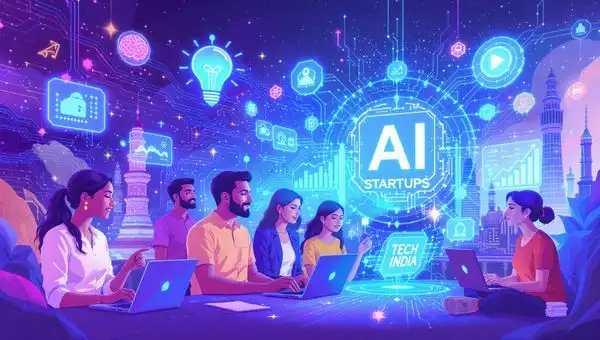
Data In → Patterns Learned → Smarter Decisions Out
-
Think: feeding a computer thousands of cat pictures, and eventually it can spot a cat in a new image.
We already use AI in everyday life:
-
Your phone’s face unlock
-
Instagram filters
-
Netflix recommending your next binge
-
Chatbots answering customer queries
Cool, right? But AI also has deeper uses in medicine, climate modeling, manufacturing, and more.
And that’s where AI startups in India step in—these are the bold teams building solutions with AI at their core, often targeting problems in India and beyond.
Why India? Why Now?
India is a land of huge opportunity—billions of people, massive data, and lots of problems waiting for tech solutions. AI can help with agriculture (predicting crop yield), healthcare (diagnosing diseases faster), education (personalized learning), smart cities, finance, and so on.
Also:
-
The Indian government is pushing AI adoption (National AI Strategy, funding, research).
-
There’s rising entrepreneurship culture.
-
Much of the world sees India as a hub for tech talent, cost-effective innovation, and diverse use cases.
So, saying “AI startups in India are interesting” is an understatement—they’re full of promise, risk, creativity, and energy.
What Makes a Great AI Startup?
Before I list 50 of them, let me tell you how I selected them (in my head). A top AI startup typically:
-
Has a clear problem statement (not “let’s use AI for everything”).
-
Uses data and machine learning models as core tech.
-
Has traction — users, paying customers, pilots.
-
Scalable: can expand beyond one city, one domain.
-
Team strength: good mix of domain, AI/ML developers, business folks.
These are the ones I find exciting. If you know others, shout out!
Best Free AI Tools for Students 2025 → “Agar aap AI me career shuru karna chahte hain bina coding ke, to ye free AI tools aapko start karne me help karenge.”
The Big List: 50 AI Startups in India (in no particular order)
Below is a curated list of AI startups in India making waves. I’m mixing well-known names with cool up-and-comers. Think of this as your AI startup directory.

1–10: Healthcare & Diagnostics
-
Qure.ai – Uses AI to read medical scans (X‑rays, CT scans).
-
SigTuple – Automates lab tests by interpreting microscope images.
-
Niramai – Uses thermal imaging + AI for early breast cancer screening.
-
HealthifyMe – Smart health app with AI-based nutrition & fitness coaching.
-
Onco.com – Personalized cancer support using AI for treatment planning.
-
Pluss – Medical device startup using AI to monitor vital signs.
-
Detect Technologies – AI for industrial health monitoring (predictive maintenance in factories).
-
Zenatix – IoT + AI for energy monitoring in hospitals/buildings.
-
Artelus – AI for diagnosing eye diseases from retina images.
-
SigNTra – AI-based neural signal processing for brain health.
11–20: Fintech, Risk, Security
-
ZestMoney – Uses machine learning to provide credit to non‑banked users.
-
Capital Float – AI-powered credit underwriting for business loans.
-
Razorpay – While payment first, also invests in AI fraud detection.
-
CreditVidya – Uses alternative data and AI for credit scoring.
-
Fyle – AI in expense management and accounting automation.
-
Cashify – Recommerce + AI for resale pricing and demand forecasting.
-
ePayLater – BNPL + AI fraud detection & user segmentation.
-
Lemonade Insurance (India arm) – AI for risk, claims, underwriting.
-
Innefu Labs – AI, cybersecurity, and pattern analysis for defense.
-
Quetzal – AI to detect financial crime, compliance monitoring.
21–30: Enterprise, Automation, Analytics
-
Haptik – Conversational AI and chatbots.
-
Yellow.ai – AI-powered customer engagement platform.
-
Mad Street Den – Visual AI: detecting fashion trends, image recognition.
-
CleverTap – AI-based user analytics and retention platform.
-
Wingify (VWO) – AI-based A/B testing and conversion optimization.
-
Fractal Analytics – Big analytics + AI for enterprise clients.
-
Sigmoid – AI and data engineering for analytics at scale.
-
Uncanny Vision – Computer vision for smart surveillance and retail analytics.
-
Netradyne – Fleet monitoring, driver behavior AI in real time.
-
WayCool – Logistics + AI to optimize agricultural supply chains.
31–40: Retail, E‑commerce & Consumer AI
-
Fynd – AI fashion retail discovery and recommendation.
-
Jubilant FoodWorks – (Their innovation arm)—AI in food delivery, demand forecasting.
-
Vernacular.ai – AI voice bots in local Indian languages.
-
LocoNav – AI for last-mile delivery and tracking.
-
Emotix – “Miko” robot – AI companion for kids.
-
Box8 – AI to forecast order flows and manage kitchen logistics.
-
Zebra Medical Vision (India branch) – AI imaging for health diagnostics.
-
Flutura – Industrial AI for oil & gas, manufacturing.
-
Robosoft – AI in mobile app and product engineering with smart features.
-
Meesho (AI team) – Using AI for recommendation, search, and catalog quality.
41–50: Deep Tech, Research, Specialty AI
-
Sigtuple – (already listed) but also deeper research wing for AI labs.
-
Vernacular.ai – (also listed) expanding into R&D design.
-
LabIn – AI lab management and tracking.
-
Aindra Systems – AI in disease detection, ultrasound interpretation.
-
Skan.ai – Automation, process mining with AI.
-
H₂O.ai India – Open source AI platform + local projects.
-
Cohere AI (India presence) – Natural language models, embeddings.
-
Emotech – Smart assistants with emotion-aware AI.
-
Skylark Drones – AI for autonomous drones, mapping, and analytics.
-
CropIn – AI-driven agritech (predictive crop health, yield, recommendations).
Benefits of AI in Education 10 points → “AI ke career options samajhne se pehle, yeh janna important hai ki AI education me kaise madad karta hai.”
Note: Some startups overlap domains; I’ve grouped them by their primary focus areas.
What Do These Startups Actually Do?
I know, names are fun, but what’s the actual magic? Let me break it down.
-
Medical Imaging & Diagnostics: They train neural networks on thousands of scans so that the AI can spot anomalies faster than—or at least help—the doctor.
-
Credit Scoring & Finance: AI sifts through data (like digital footprints, bills, transaction patterns) to decide whether to give you a loan.
-
Chatbots & Voice AI: These startups teach machines to understand you—whether you speak English, Hindi, Tamil, Telugu—and respond like you’re chatting with a person.
-
Retail & E-commerce: Predicting which product you’ll like, when to send discounts, optimizing inventory—these are powered by AI.
-
Enterprise Analytics: Helping big companies detect patterns, anomalies, bottlenecks using smart dashboards, alerts, and forecasts.
-
Deep Tech & Research: Working on the foundational stuff—robotics, embeddings, drone vision, algorithms—so future breakthroughs emerge.
These use cases are real and already impacting millions of lives.
Benefits of AI — Why It Matters
You might ask: “Okay, cool tech, but what’s in it for society?” Here are a few big wins:
-
Scalability: Solutions can reach millions (e.g., in healthcare, diagnostics) with less manpower.
-
Speed & Efficiency: Machines can process data faster than humans—diagnose faster, detect fraud in real-time.
-
Cost Reduction: Once systems are built, cost per unit drops (e.g., less manual review work).
-
Personalization: From education to shopping to health, AI can tailor experiences uniquely for you.
-
New Job Creation: AI doesn’t just replace jobs; it also creates roles—data scientists, ML engineers, AI ethicists.
Limitations & Challenges (Let’s Be Real)
Of course, nothing’s perfect. AI has its share of challenges:
-
Data Privacy & Ethics: Training on health or personal data raises privacy concerns.
-
Biases: If training data is skewed (say overrepresenting one group), AI can make unfair decisions.
-
Explainability: Sometimes a model says “reject loan” without explaining why. That’s a problem.
-
Infrastructure & Cost: High compute power, cloud costs, GPUs—these are expensive.
-
Regulation & Trust: People may resist AI—e.g. trusting a “robot doctor” is harder than trusting a human.
-
Talent Gap: Although India has strong talent, the demand for AI skills often outstrips supply.
So while AI is magical, it’s still grounded in trade‑offs, and these need careful attention (by founders, regulators, and users).
How to Use AI — Even If You’re Not a Startup Founder
Maybe you’re a student, employee, freelancer, or just curious. Here are actionable ideas:
-
Learn the Basics: Start with Python, statistics, linear algebra, then move to ML courses (Coursera, Udacity, etc.).
-
Hands-On Projects: Build simple AI apps—spam detector, image classifier, chat bot.
-
Use AI Tools: Play with OpenAI’s APIs, Hugging Face models, Google’s Vision API—see what they can do.
-
Intern or Volunteer: Get experience in an AI team at one of the startups above (or others).
-
Participate in Challenges: Join Kaggle, AI hackathons, competitions (e.g., Indian government challenges).
-
Stay Ethical: Think about fairness, privacy, explainability as you build.
Even if you never launch an AI startup, these skills will put you ahead in many tech roles.
The Future of AI Startups in India
What’s next? I’ll hazard a few guesses (with my fingers crossed).
-
AI + Edge / IoT: More devices will process data locally—smart sensors, drones, wearables.
-
Language & Voice Expansion: More startups will build AI in regional Indian languages (Marathi, Bengali, Gujarati).
-
AI in Agriculture: Precision farming, disease detection, yield prediction—lots more real use.
-
AutoML & Low-code AI: Tools to empower non-experts to build AI solutions.
-
Responsible AI & Regulation: More rules, audits, transparency by design.
-
Deep Tech Breakthroughs: Indian startups could start pushing core AI research (not just application).
If you ask me, there’s a huge chance India becomes a global AI hub, not just for outsourcing, but for groundbreaking solutions.
Tips for Founders & Aspiring AI Enthusiasts
If you’re thinking “Maybe I want to build an AI startup in India,” here are a few suggestions:
-
Pick a Niche Problem: Don’t try to invent the wheel. Solve a specific real problem in health, agri, logistics, etc.
-
Get Early Feedback: Test with real users early. Use minimal viable AI — simple models, prototypes.
-
Acquire Good Data: AI is data hungry. Build partnerships to gather quality data.
-
Focus on Explainability & Ethics: From day one, be transparent about how your models work.
-
Build a Strong Team: You need domain experts + ML folks + business people.
-
Raise Smart Money: Seek investors who understand AI, not just those chasing buzzwords.
-
Scale Globally (if possible): Don’t confine to one state or city. If your idea works, expand.
-
Stay Updated: AI is fast-moving. Read academia, latest models, attend conferences, join communities.
2–3 Subheadings with the Keyword “AI startups in India”
I’ve already used “AI startups in India” in the title and first paragraph. Here are a couple of subheadings where I do so again:
How do AI startups in India find early customers?
Early customers often come from pilot projects with hospitals, small cities’ municipalities, SME clients. Because the problems in India are unique (local languages, infrastructure constraints), startups often partner with NGOs, governments, or large enterprises to prove value.
What challenges do AI startups in India face in scaling?
Scaling from one state to another means handling new dialects, new data distributions, government approvals, infrastructure issues (internet, compute), trust, and costs. Many AI startups in India find scaling to rural or resource-limited areas especially tough, because models built for metros may not generalize.
Why This List Matters for You (Reader)
You may ask: “Why should I care about AI startups in India?” Well:
-
These startups shape the future services you’ll use—healthcare, education, agriculture.
-
Knowing them can help you find jobs, internships, collaborative projects.
-
If you ever want to build your own tech business, this is a goldmine of ideas.
-
You get inspired—seeing people doing amazing things in AI in our own country.
Plus, it’s just cool to know which names are doing what.
Lightning Round: Top Picks I’m Most Excited About
Here are 5 AI startups in India I personally keep an eye on:
-
Qure.ai: Diagnosing scans faster and helping in remote areas.
-
Niramai: Tackling a serious problem—breast cancer detection early.
-
Yellow.ai: Conversational AI that speaks in your language.
-
CropIn: Helping farmers make smarter decisions.
-
Uncanny Vision: Building computer vision tech that can be used across retail, security.
Actionable Takeaways (Your Next Steps)
-
Pick one AI startup in India from the list above and explore their website—see what they do, what problems they address.
-
Try building a mini-project: cat/dog classifier, sentiment analyzer, or local language chatbot.
-
Join communities—AI meetups in India, online forums, hackathons.
-
Follow AI research newsletters—stay curious and learn.
-
If you’re bold, pitch a small idea solving a problem you see around you, and bootstrap it.
People Also Ask (FAQ Section)
Q1: What are some top AI startups in India?
A1: There are many, including Qure.ai, Niramai, Yellow.ai, CropIn, Fractal Analytics, SigTuple, and others. Each works in sectors like healthcare, finance, agriculture, enterprise AI, and more.
Q2: How can I join or work with AI startups in India?
A2: Build skills in programming, math, ML frameworks. Work on projects, contribute to open source, intern at startups, network through meetups/events, and showcase your portfolio.
Q3: What’s the biggest challenge for AI startups in India?
A3: Key challenges include data privacy, biased datasets, scalability in low-resource regions, cost of compute, and gaining trust/regulation in sectors like healthcare.
Q4: What sectors are AI startups in India focusing on?
A4: They focus largely on healthcare, fintech, agriculture, retail, enterprise analytics, computer vision, conversational AI, and deep tech R&D.
Q5: Can AI startups in India scale globally?
A5: Absolutely. Some already serve clients abroad. But scaling requires adapting to new markets, languages, regulations, and infrastructure.
Q6: How do AI startups in India fund their operations?
A6: Through angel investors, venture capital, government grants, corporate partnerships, and pilot contracts with enterprises or public institutions.
Q7: How do I keep up with new AI startups in India?
A7: Follow tech news, startup platforms, AI conferences, LinkedIn posts by founders, incubators, and startup directories focused on AI and innovation in India.
Conclusion
So, there you have it—my tour through AI startups in India, sprinkled with stories, tips, and ideas you can actually use. I hope this feels like chatting over coffee, not a lecture. AI isn’t just about code and robots—it’s about solving real problems, improving lives, and pushing what’s possible.