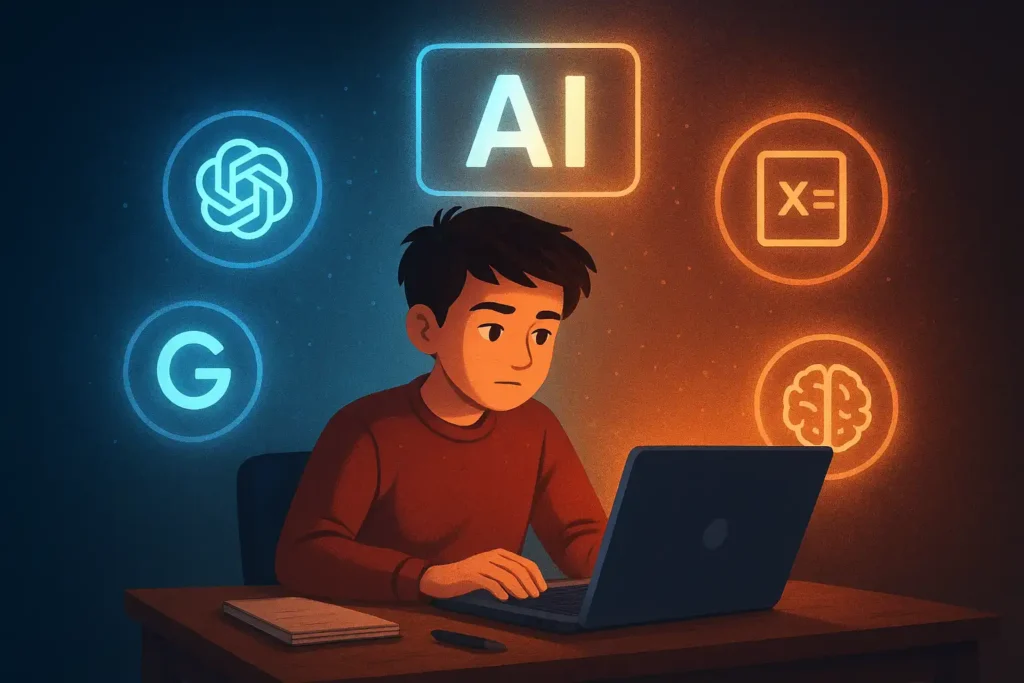
Let’s be honest — AI is everywhere. From writing essays to solving math problems, students today have a digital buddy who never sleeps — Artificial Intelligence.
But here’s the big question: Is AI use for students really helpful, or is it secretly making us lazier and overdependent?
I remember the first time I tried ChatGPT (yeah, guilty ). I had a history project due the next morning, and instead of flipping through my old notes, I typed a quick question into the AI. Within seconds, boom! I had a beautifully structured summary. It felt magical… until I realized I couldn’t explain half of it in class the next day.
So yeah — AI can be a blessing and a trap, depending on how you use it.
In this post, we’ll chat about:
-
The benefits and dangers of AI in education
-
The real risks of AI for students
-
How AI tools impact daily student life
-
And most importantly, how you can make AI your study partner, not your crutch.
Grab a coffee, and let’s dive in
What Exactly Is AI Use for Students?
In simple terms, AI use for students means using artificial intelligence tools, apps, and platforms to help with studies, assignments, research, and skill-building.
Think about tools like:
-
ChatGPT – for writing help and brainstorming ideas
-
Grammarly – for grammar and clarity improvement
-
QuillBot – for paraphrasing and summarizing
-
Photomath – for solving tricky math equations
-
Notion AI – for organizing study notes
Pretty handy, right? AI has made it easier to learn faster, stay organized, and even get personalized study plans. But… It’s not all sunshine and rainbows.
Let’s first talk about the good stuff
The Bright Side — Benefits of AI Use for Students
When used the right way, AI in student life can be a total game-changer. Here are some benefits you’ve probably noticed (and maybe a few you haven’t):
1. Smarter Learning Made Simple
AI tools can explain complex concepts in seconds.
Don’t understand quantum physics? Just ask your AI assistant to explain it like you’re five — and it will!
Example: You can ask, “Explain photosynthesis in one paragraph,” and get an answer faster than flipping a single page of your science book.
2. Personalized Study Support
Traditional learning gives the same lessons to everyone. AI, on the other hand, adapts to you.
If you’re slow in math but strong in English, AI apps like Khanmigo or Coursera AI tutor can adjust lessons to your level. That’s personalized education, without the expensive private tutor.
3. Saves Time and Reduces Stress
Let’s be real — college life can be chaotic. Between assignments, projects, and exams, there’s barely time to breathe. AI helps you manage your workload smartly.
Tools like Notion AI or ChatGPT can create study schedules, summarize research papers, and even generate flashcards for revision.
The result? More learning, less burnout.
4. Boosts Creativity and Confidence
Ever stared at a blank page thinking, “Where do I even start?”
AI can spark creativity by giving you outlines, topic ideas, or sentence starters.
When you’re stuck, AI doesn’t judge — it just helps you move forward.
The Flip Side — Risks of AI for Students
Okay, so AI sounds amazing. But like any powerful tool, it comes with risks.
Here’s where things can go wrong (and how you can avoid those pitfalls 👇):
1. Overdependence on AI
This is the biggest danger.
If you let AI do your assignments, write your essays, or solve every question, you’ll eventually forget how to think for yourself.
It’s like using a calculator for basic addition — convenient, but you lose touch with the basics.
Tip: Use AI as a helper, not a substitute for your brain.
2. Risk of Plagiarism and Academic Penalties
Many students are unaware that AI-generated text can be detected as plagiarized by plagiarism detectors.
Schools are getting smarter — they’re using AI detection software too.
So, if you’re submitting something entirely written by ChatGPT or any AI tool, you might get caught.
Pro Tip: Always review, edit, and add your personal touch. Make it sound like you, not a robot.
3. Reduced Critical Thinking Skills
AI gives answers too easily.
When you rely on it too much, you stop questioning or analyzing things deeply.
Think about it: If AI gives you an answer, do you double-check it? Most students don’t. That’s where the real learning stops.
4. Privacy and Data Concerns
AI platforms collect data — what you type, what you ask, even your learning patterns.
If not used carefully, this data could be shared with third parties.
So always check an app’s privacy policy before signing up. Avoid sharing personal info like your school, address, or full name on open AI tools.
5. Paid Tools and Inequality in Access
Some of the best AI tools aren’t free.
This creates a gap — students who can pay get access to advanced help, while others are left behind.
Solution: Look for free AI tools for students (like ChatGPT Free, Grammarly Basic, and QuillBot Free). They’re still super powerful!
Real-Life Scenarios — AI in Student Life
Let’s look at how AI use for students actually plays out in everyday life.
Example 1: The Assignment Shortcut
You’ve got a 1,000-word essay due tomorrow. Instead of researching for hours, you type your topic into ChatGPT.
In minutes, you’ve got a clean draft. You tweak a few lines, add your name, and submit.
Sounds great — until your teacher asks a question from your essay, and you have no clue how to answer.
That’s when you realize AI did your homework, not your learning.
Example 2: The Study Partner That Never Sleeps
On the flip side, using AI wisely — like asking it to summarize notes, explain difficult concepts, or create quizzes — can make you more productive and confident.
Think of AI as your digital study buddy who’s always awake when you’re cramming at 2 a.m.
The Most Popular AI Tools for Students and Their Impact
Let’s go through a few powerful AI tools that are changing student life (and how they can help you without crossing ethical lines):
| Tool Name | Best For | How It Helps |
|---|---|---|
| ChatGPT | Writing, research, and brainstorming | Helps generate ideas, summarize topics, and create outlines |
| Grammarly | Writing improvement | Fixes grammar, tone, and structure issues |
| Notion AI | Productivity and organization | Makes study plans, reminders, and note summaries |
| Photomath | Solving math problems | Explains steps, not just answers |
| QuillBot | Paraphrasing and rewording | Makes content unique and more natural |
All these tools, when used smartly, boost learning instead of replacing it.
How to Use AI Wisely as a Student
Let’s make this super practical.
Here’s how you can use AI to your advantage without falling into the “lazy trap.”
1. Use AI for Research, Not Copying
Ask AI to explain or summarize a topic, but write the final version in your own words.
2. Double-Check Facts
AI sometimes “hallucinates” — meaning it gives wrong info confidently. Always verify from credible sources.
3. Combine AI with Real Study
If AI gives you an answer, take a few minutes to understand why it’s right. That’s where real learning happens.
4. Keep It Ethical
Don’t use AI for exams, cheating, or plagiarism. Use it to learn smarter, not shortcut the process.
The Emotional Side — Is AI Making Us Numb?
Here’s something few people talk about.
When AI starts thinking for us, we slowly lose confidence in our own ability to think deeply.
That’s scary, right?
Students who overuse AI might find it harder to focus, remember information, or express original ideas.
So the trick is to strike a balance — let AI help you, but keep your brain in the driver’s seat.
FAQs
Is AI use for students good or bad?
It’s both! AI is great when used for learning and productivity, but risky when used to avoid actual study or thinking.
What are the main risks of AI for students?
Overdependence, plagiarism, loss of creativity, privacy issues, and misinformation.
How can students use AI safely?
Use it as a study assistant — for summaries, research help, or note organization — but always review and personalize the output.
What are the benefits and dangers of AI in education?
Benefits include personalized learning and productivity; dangers involve academic dishonesty, reduced thinking, and data misuse.
Can AI replace teachers?
Nope. AI can support teachers, but emotional understanding, guidance, and motivation come only from real humans.
Conclusion
AI isn’t the enemy. It’s a powerful tool — just like a calculator or the internet once was.
The key is how you use it.
If you treat AI as your digital mentor — to learn faster, think deeper, and explore wider — you’ll thrive.
But if you treat it as your shortcut, you’ll end up skipping the most important part: learning itself.
So, the next time you open ChatGPT or Grammarly, remember this simple rule:
Let AI assist you, not replace you.
Because the smartest students of tomorrow won’t be the ones who use AI the most —
They’ll be the ones who know how to use it wisely.