Remember when “classroom technology” meant an overhead projector and a squeaky whiteboard marker? Yeah, me too. Well, buckle up, because education is getting a major tech upgrade, and it’s way more exciting than those scratchy film strips we suffered through.
I’m talking about Artificial Intelligence — or as most of us call it, AI.
When I first heard “AI in education”, I’ll admit I pictured robot teachers and students plugged into computers. The reality? It’s cooler — and honestly, way more human. AI isn’t about replacing teachers; it’s about giving them — and you — superpowers.
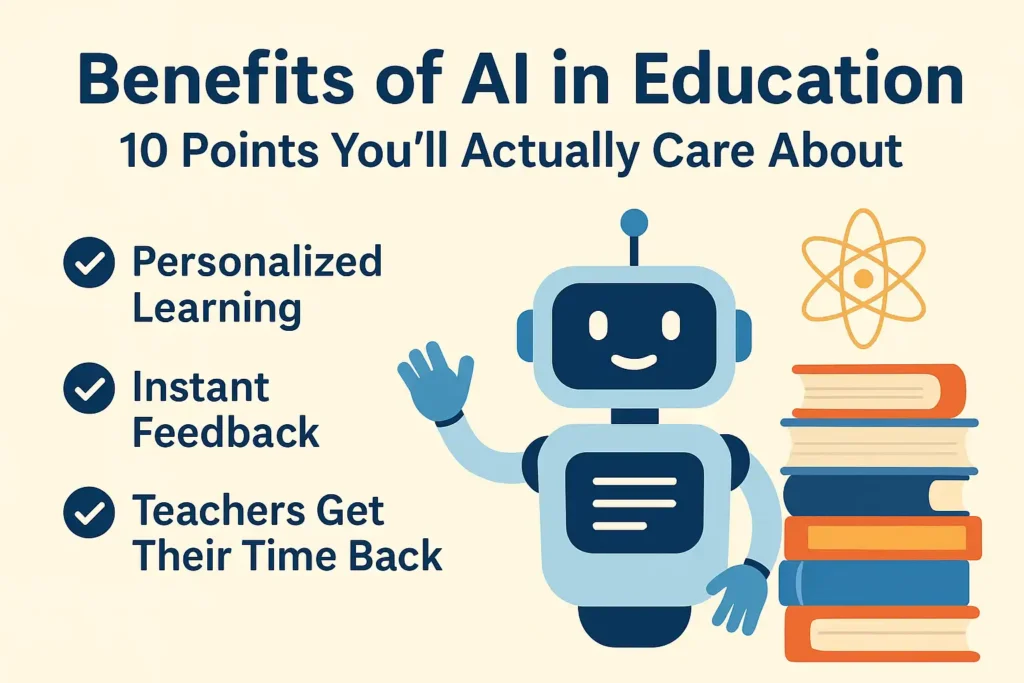
So, what exactly are the benefits of AI in education 10 points we should all know about? I’ve done the homework (see what I did there?), and I’m excited to walk you through how AI is making learning more personal, teaching more rewarding, and education more accessible for everyone.
Wait, What Is AI Again? Let’s Break It Down
Before we dive into the good stuff, let’s get on the same page.
If you’re imagining some sci-fi robot that talks in beeps and boops, let’s dial it back. AI, in simple terms, is technology that mimics human intelligence. Think about:
- Netflix is recommending that thriller you binge-watched.
- Google Maps is saving you from that awful traffic jam.
- Your phone unlocks just by looking at it.
That’s AI at work.
In education, AI tools don’t wear lab coats or hand out detentions. They:
- Recognize patterns (like knowing you struggle with fractions but love geometry).
- Understand and respond to questions (like chatbots or smart tutors).
- Learn from your performance (and improve recommendations over time).
- Help generate new content (like essays, quizzes, and even videos).
Now that we’re clear, let’s explore how AI is changing the way we learn — one algorithm at a time.
The Top 10 Benefits of AI in Education
1. Learning That Actually Gets You
Remember sitting in class completely confused while your friend was bored out of their mind?
AI fixes that. It adjusts to how you learn best — visual, auditory, hands-on, whatever your vibe is. It can:
- Simplify complex topics.
- Serve content at your pace.
- Focus more on areas where you struggle.
It’s like a personal tutor that never gets tired. Students using adaptive learning platforms are already experiencing this, and honestly, it makes old-school worksheets look sad.
2. Instant Feedback (No More Waiting Weeks!)
Raise your hand if you’ve submitted an assignment… and waited days (or weeks) for feedback.
AI says nope to delays.
It gives you instant feedback — highlighting grammar issues, giving suggestions, and even showing what to improve in your math or science work. It’s fast, it’s specific, and it helps you grow in real-time.
Of course, teachers still add their human insight. But now they don’t have to spend hours doing what a tool can handle in seconds.
3. Teachers Get Their Time Back
Teachers do a lot more than teach — grading papers, answering emails, handling admin stuff. It’s exhausting.
AI lightens the load by:
- Grading assignments.
- Scheduling meetings.
- Drafting parent emails.
- Organizing student data.
That means more energy goes into actual teaching and building connections with students. Some teachers have even used AI to tailor summer schedules based on parent input. Time saved = lives improved.
4. Learning Without Limits
AI is a game-changer for inclusive education. It supports:
- Text-to-speech for visual impairments.
- Voice-to-text for motor disabilities.
- Real-time translations for non-native speakers.
- Custom interfaces for neurodivergent learners.
This isn’t about “fixing” students. It’s about making learning accessible to everyone, in ways that weren’t possible before.
5. Making Abstract Concepts Make Sense
Remember trying to learn about molecules or the solar system… from a textbook diagram?
AI helps you see what you’re learning. It can create:
- 3D visualizations of geometric shapes.
- Images of historical places.
- Simulations of scientific experiments.
It turns the abstract into the tangible. And suddenly, lessons are way more memorable.
6. Tutoring Support for Everyone
Not everyone can afford private tutoring. AI helps bridge that gap.
Using AI-powered tutors and assistants, students can:
- Get help with homework.
- Practice concepts through exercises.
- Receive instant clarification on tough topics.
Best part? It’s available anytime, anywhere, and for free (or very low cost). It’s like having a study buddy who never gets tired — or annoyed.
7. Content Creation on Steroids
Teachers, listen up — AI is your new best friend for creating engaging lesson plans and activities.
It can:
- Generate quizzes and discussion questions.
- Build customized presentations.
- Suggest real-world examples to explain tricky topics.
One teacher used AI to create math word problems based on her students’ favorite video games — now that’s how you get them to pay attention!
8. Building Better Thinkers, Not Just Memorizers
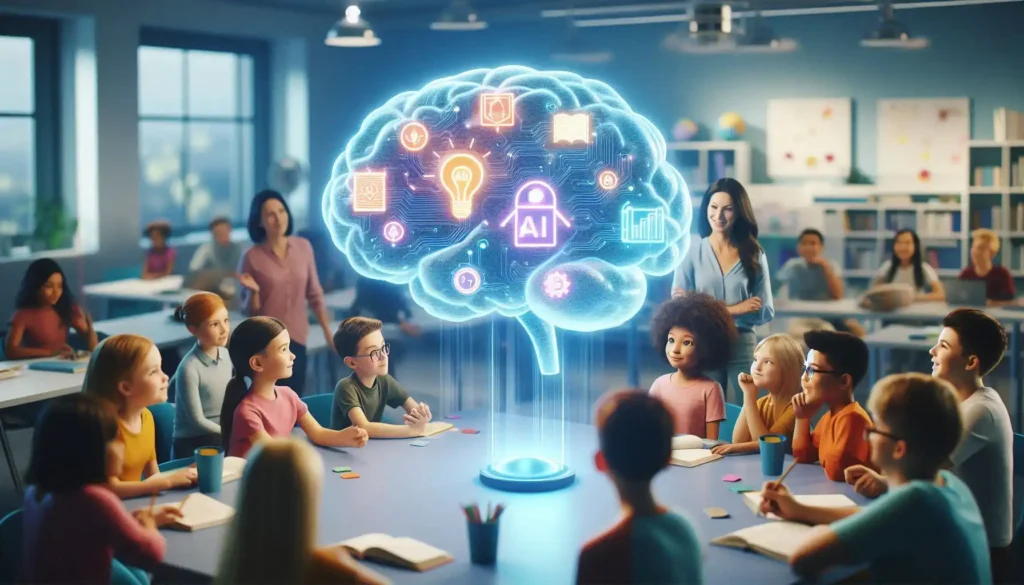
Worried that students will just use AI to cheat? Fair concern. But here’s the flip side:
With basic tasks handled by AI, students can focus on critical thinking, like:
- Analyzing info for bias.
- Comparing sources.
- Asking better questions.
- Solving real-world problems creatively.
Teachers are using AI as a launchpad for deeper conversations about ethics, media literacy, and digital responsibility. And that’s something every future-ready student needs.
9. Smarter Career Guidance
AI isn’t just helping in the classroom — it’s helping students plan their futures.
It can:
- Analyze job market trends.
- Suggest relevant courses and skills.
- Recommend personalized career paths.
Instead of generic advice, students get insights based on real-time data — and that can make all the difference in choosing the right path.
10. Learning Anytime, Anywhere
AI doesn’t sleep. Which means you can learn whenever inspiration strikes — even at 2:00 AM before finals (we’ve all been there).
Whether you’re:
- Catching up on a missed class,
- Reviewing before an exam,
- Or learning for fun…
AI tools are there 24/7, offering consistent support across time zones, schedules, and lifestyles.
Let’s Not Ignore the Challenges
As much as I love AI, it’s not all rainbows and unicorns. Some things to watch out for:
Privacy and Security
AI tools often collect data. Schools and developers need to be super careful about protecting student info.
Bias in Algorithms
AI can reflect biases from the data it was trained on. That means educators and students need to stay alert and question the info AI provides.
Over-reliance
AI is helpful, but don’t let it do all the thinking. Students still need to develop curiosity, problem-solving, and human connection.
The Future Is Human + AI, Not Human vs AI
Let’s be clear: AI isn’t replacing teachers.
It’s making their lives easier, their teaching more impactful, and their students more engaged.
In the future, we’ll see:
- Smarter classrooms that adjust to each learner.
- Teachers are spending more time mentoring, less time grading.
- Students using AI as a partner in learning, not a shortcut.
How You Can Start Using AI in Learning Today
If You’re a Student:
- Use AI tools to practice tough subjects.
- Try writing assistants for editing (but always write your own thoughts).
- Experiment with AI apps to find what suits your style.
- Fact-check AI responses — always!
If You’re an Educator:
- Use AI to handle repetitive tasks like emails or lesson planning.
- Teach students how to use AI responsibly.
- Use AI to differentiate instruction — tailor lessons to different needs.
- Collaborate with other educators to share ideas and tools.
Final Thoughts: Learning Just Got Smarter
After going through the benefits of AI in education (10 points), one thing’s clear: AI isn’t about replacing people — it’s about empowering them.
Whether you’re a student looking for extra help, a teacher juggling a dozen things at once, or just someone curious about tech — AI is opening doors for better, more inclusive, and more personalized learning.
And hey, the next time you hear someone say AI is going to “take over,” just tell them it’s already teaching algebra better than most of us ever could. 😉
What are your thoughts on AI in education? Let’s chat — drop your questions, stories, or wild ideas below. This conversation is just getting started.
People Also Ask: FAQs
1. What is Artificial Intelligence?
AI is technology that allows machines to think, learn, and solve problems like humans. In education, it helps personalize learning and automate tasks.
2. How is AI used in daily life?
From music recommendations to voice assistants, AI helps with routine tasks, decision-making, and problem-solving in everyday life.
3. Is AI dangerous?
Not inherently. But if misused — like invading privacy or spreading bias — it can be. Responsible use and ethical design are key.
4. Can AI replace human teachers?
No. AI supports teachers by handling repetitive tasks and offering data insights, but it can’t replace empathy, connection, or mentorship.
5. How can students learn AI?
Start with free tools and courses online. Practice using AI platforms, explore how they work, and apply what you learn in schoolwork or projects.
6. Does AI ever make mistakes?
Yes! AI can generate wrong or biased information. It’s smart — but not perfect. Always double-check and use your judgment.